Before Dublin: Five Questions the European AI Innovation Month Must Answer on Governance
On Wednesday 14 October, Dublin opens the European AI Innovation Month. Over the next five weeks, three flagship summits, a virtual conference platform and a list of partner events will try to show how AI is being developed and used across European industry.
The opening summit has a clear theme: “harnessing AI to revolutionise Europe’s competitiveness”. It is a fair ambition. It is also the kind of framing in which governance tends to become a footnote, something mentioned in a panel on trust and then left to the lawyers.
This is not a preview of the programme. It is a list of five questions about governance and evidence that decision-makers can carry into the month, and use to judge what comes out of it.
One month, three summits
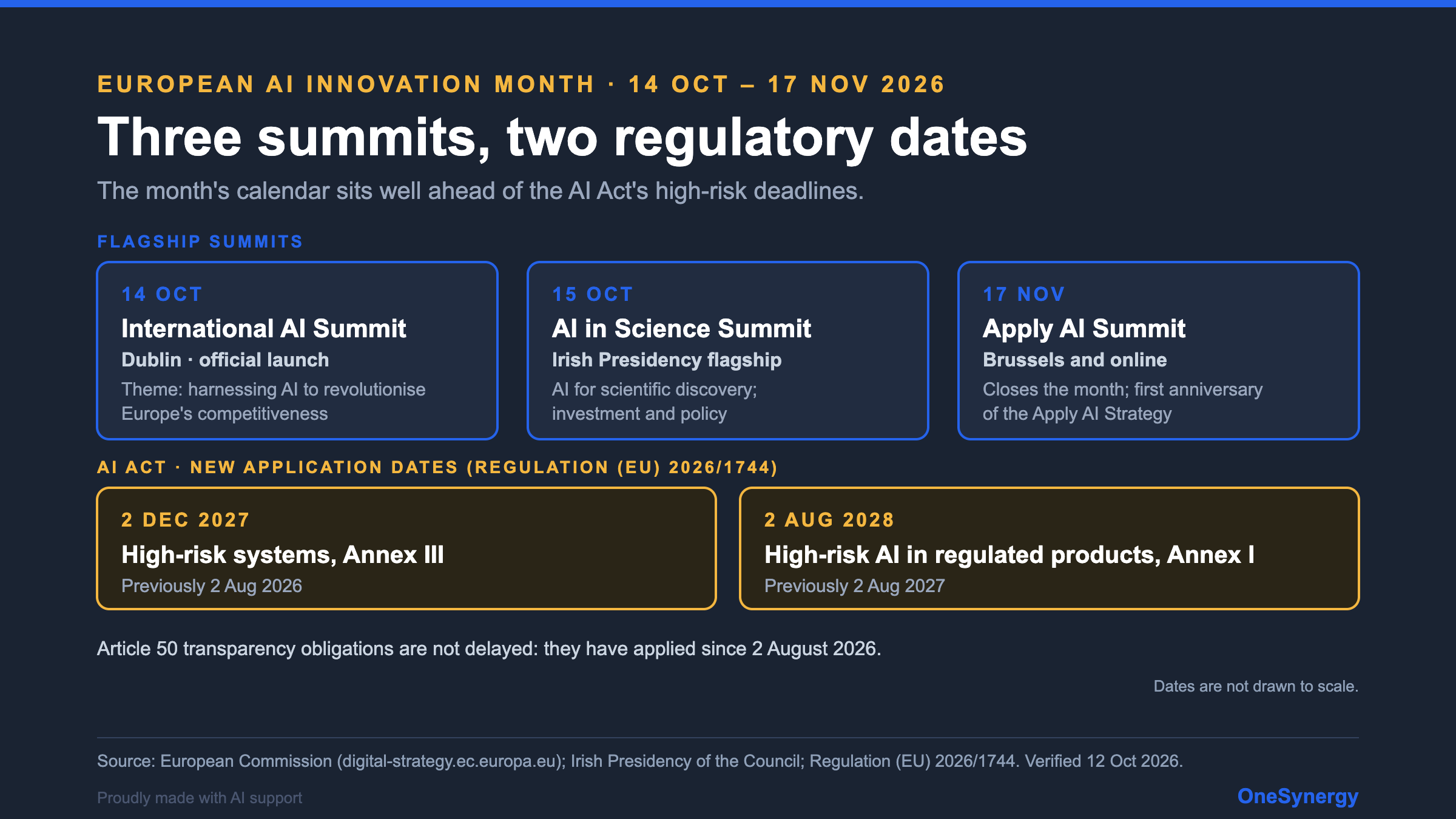
The European Commission leads the initiative in partnership with the Irish Presidency of the Council, and it runs from 14 October to 17 November 2026. The Commission’s page names three flagship events. The International AI Summit in Dublin on 14 October is the official launch. The AI in Science Summit follows on 15 October. The Apply AI Summit on 17 November, in Brussels and online, closes the month and marks the first anniversary of the Apply AI Strategy.
According to the Irish government, the Dublin summit is a full-day event of ministerial addresses, keynotes, panels and fireside chats, with European Executive Vice-President Henna Virkkunen confirmed as a keynote speaker. The Presidency’s own page lists three discussion themes: applied AI and sectoral value creation, infrastructure and Europe’s AI capacity, and the AI opportunity ahead. Those are competitiveness themes. Governance appears elsewhere in the description, under “trustworthy AI”. That is a reasonable place to start asking.
Around the flagships, partner events will run across Europe throughout the month, and the Apply AI Alliance calendar lists further stakeholder-led events. The question is less where to be than what to listen for.
1. After the delay, who is measuring readiness?
The AI Omnibus (Regulation (EU) 2026/1744) entered into force on 27 July 2026. It pushed back the start of the rules for high-risk systems. Stand-alone systems listed in Annex III now fall under them from 2 December 2027, and AI built into regulated products such as machinery, toys and lifts from 2 August 2028. The original dates were 2 August 2026 and 2 August 2027.
More time is only useful if someone uses it. The risk is a collective pause, in which “later” quietly turns into “not yet a priority”. Not everything has moved, though. The transparency obligations in Article 50 have applied since 2 August 2026, with a grace period until 2 December 2026 for the marking of generative systems already on the market before that date.
The work that does not depend on the dates is the same everywhere: knowing which AI systems you build or use, which of them could fall into a high-risk category, and who owns each one. Organisations that do that inventory now will spend 2027 improving. Those that wait will spend it catching up.
The question for Dublin: will anyone say what an organisation should have in place by the end of 2026, and how we will know whether European companies are on track?
2. A year after Apply AI, what counts as evidence?
The Apply AI Strategy promotes an “AI first” approach: when organisations take strategic or policy decisions, AI should be considered as a possible solution, weighing benefits and risks. It covers ten industrial sectors and the public sector. To coordinate the work, it relies on the Apply AI Alliance, a forum for providers, industry, academia and the public sector, and on an AI Observatory that will track trends and assess impact.
On 17 November, the strategy turns one. Adoption figures are the easy part. The harder part is what the Observatory measures besides usage: whether organisations can show human oversight, documentation and incident handling for the systems they deploy.
The question for the month: what indicators will be used to judge the first year, and do they include evidence of control, or only evidence of use?
3. Is governance a cost, or part of the competitiveness case?
The Omnibus extends some of the relief once reserved for small and medium-sized enterprises to small mid-cap companies, and it simplifies the AI literacy duty, giving the Commission and Member States a stronger role in promoting it. Those are real reductions in burden.
They do not remove the need to be able to show how a system was chosen, how it is supervised and who is accountable. Buyers will ask for that, and the Apply AI Strategy itself favours a “buy European” approach, particularly in the public sector. In procurement, governance is not a tax on competitiveness. It is often a condition for being considered at all.
The question for Dublin: will the competitiveness agenda treat governance as an asset that companies can show to customers, or as a cost to be minimised?
4. How does science reach the company?
The AI in Science Summit on 15 October is coordinated by University College Dublin and Taighde Éireann (Research Ireland), as an official event of the Irish Presidency. The Commission describes it as a place to explore how AI can transform scientific discovery, with sessions on driving investment and policy in each scientific field. It is linked to the Resource for AI Science in Europe (RAISE), a pilot that pools funding, compute, data and talent.
Healthcare and pharmaceuticals are the first sector on the Apply AI list, and the one where the distance between a research result and a deployable, accountable product is longest. A model that works in a laboratory is not yet a system a hospital or a small biotech can adopt, validate and defend.
The question: what is the path from a scientific AI model to a company that has to use it responsibly, and who validates the steps in between?
5. Who pays for the unglamorous part?
Documentation, oversight capacity, training and internal ownership are not exciting expenses, and they do not appear in many funding calls. Even with the AI literacy duty softened, the capacity inside companies still has to come from somewhere.
The next long-term EU budget, for 2028 to 2034, is being negotiated now. The Commission’s proposal includes a European Competitiveness Fund, and on 16 June 2026 the Council adopted its partial negotiating position on it. Whatever the final shape, the useful question is what such funds will pay for: technology only, or also the governance capacity that lets organisations use it safely.
The question for the month: will funding follow the whole chain, from tools to the people and procedures that make them accountable?
How to use the month
You do not need to follow every session. Three signals are enough:
- On 14 October, whether governance gets its own space or stays inside the trust panel.
- Between 15 and 17 November, whether the science and adoption tracks produce any shared indicators, or remain separate conversations.
- On 17 November, whether the first-anniversary assessment of Apply AI measures control as well as adoption.
Write down what is said on those three points, and compare it with the dates that have not moved. The AI Act’s main obligations for high-risk systems are now more than a year away. The decisions that determine whether Europe is ready for them are being taken in the meantime.
Related reading
- The EU AI Omnibus Deal: What the May 7 Agreement Means for Your AI Compliance Timeline
- Your AI Agents Are Running. The High-Risk Rules Are Not. What Changed on 2 August 2026
- Before AI Week: The Five Questions European AI Strategy Must Answer in 2026
Sources
- European Commission, European AI Innovation Month (page updated 8 October 2026)
- Irish Presidency of the Council of the EU, International AI Summit
- Government of Ireland, International AI Summit 2026
- AIS26, AI in Science Summit 2026
- European Commission, Apply AI Strategy (page updated 5 October 2026)
- European Commission, AI Omnibus enters into force (27 July 2026, updated 31 July 2026)
- Regulation (EU) 2026/1744 (Digital Omnibus on AI)