
Europe Discovers the Molecules. Who Builds the Companies? AI, Drug Discovery and the Spin-Off Gap
In 2021, a London company spun out of Google DeepMind with a deliberately immodest goal: to redesign how medicines are discovered. Five years later, Isomorphic Labs is preparing to dose its first patients, advancing cancer candidates designed with AlphaFold-derived models toward the clinic, backed by a 600 million dollar external round raised in March 2025 and drug-design partnerships with Eli Lilly and Novartis. The science that earned a Nobel Prize for protein-structure prediction is now becoming a company, a pipeline, and a clinical question.
That trajectory captures a shift in AI drug discovery that every European innovation leader should be reading closely. For two decades, the hard part of early drug discovery was the discovery itself: finding a molecule worth developing took years of wet-lab iteration and a great deal of luck. AI is compressing that step. As the cost and time of generating a credible drug candidate fall, the bottleneck moves downstream. The scarce resource is no longer the insight. It is the company built around it, and the capital and structure required to carry that company from a university bench to a clinical asset.
For Europe, this is both an opening and an uncomfortable mirror. The continent produces world-class science. It has been slower at turning that science into scaled companies. AI changes the economics of the first step in a way that makes the second step more urgent, not less.
What AI drug discovery actually changes in the pipeline
The useful conversation about AI in drug discovery is specific rather than sweeping. AI does not replace pharmacology or clinical trials. It changes the speed, cost, and hit rate of distinct stages, and it does so unevenly. The table below separates where the impact is already real from where it remains promising.
| Discovery stage | What AI contributes | Maturity in 2026 |
|---|---|---|
| Target identification | Finding and prioritising disease-relevant targets from multi-omic and clinical data | Growing, evidence accumulating |
| Protein structure and design | Predicting structures and designing binders, accelerated by AlphaFold-class models | Strong and widely adopted |
| Molecule and antibody generation | Generative models proposing novel candidates with desired properties | Strong, rapidly maturing |
| Lead optimisation | Predicting potency, selectivity and developability to reduce wet-lab cycles | Solid, real time savings |
| Preclinical and trial design | Modelling toxicity, selecting biomarkers, refining patient stratification | Emerging, uneven |
| Clinical validation | Proving AI-designed candidates are safe and effective in humans | Unproven at scale, the decisive test |
The honest reading is that AI has moved fastest where biology is most computable, in structure and molecular design, and slowest where human complexity dominates, in the clinic. The first AI-designed molecules entering human trials in 2026 are the experiment that matters. Until those readouts arrive, the value created by AI sits mostly in the early pipeline. That is precisely the part of the value chain where new companies are born.
The market is pricing in the shift
Investors and analysts have noticed. Europe’s market for AI in antibody discovery alone is forecast to grow from 153.8 million dollars in 2025 to 1.43 billion dollars by 2035, a compound annual growth rate of roughly 25 percent. Estimates for the broader global AI drug discovery market in 2026 range widely depending on definitions, from under 3 billion to more than 8 billion dollars, but the direction is consistent across every serious forecast.
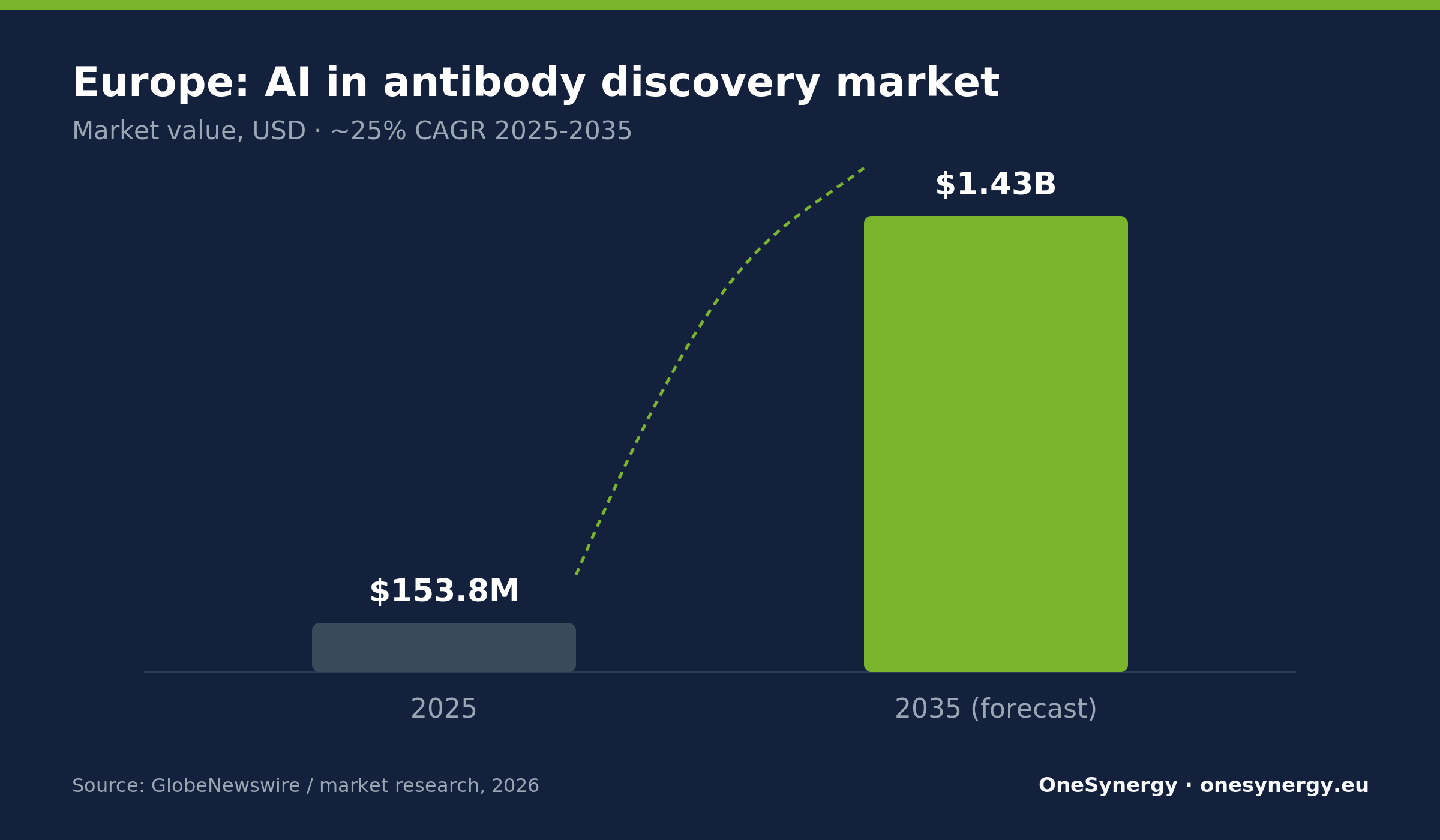
Market forecasts are directional rather than precise, and they should be read with the usual caution. What they signal is that capital expects AI-native discovery to become a structural part of how medicines are made, not a passing experiment. The strategic question for European organisations is whether the companies capturing that value will be built in Europe or elsewhere.
Europe’s paradox: the science is here, the capital is not
This is where the mirror gets uncomfortable. Europe holds a share of the world’s most-cited biomedical research comparable to the United States and China. It converts far less of that research into scaled, well-funded companies.
The capital gap is stark. Between 2015 and mid-2025, biotech startups in the European Union attracted around 25 billion euros in venture capital. The comparable figure in the United States was about 219 billion euros. European biotech accounts for roughly 7 percent of global venture funding in the sector. And of the 67 EU biotech companies that went public over the past six years, 66 chose to list outside Europe.
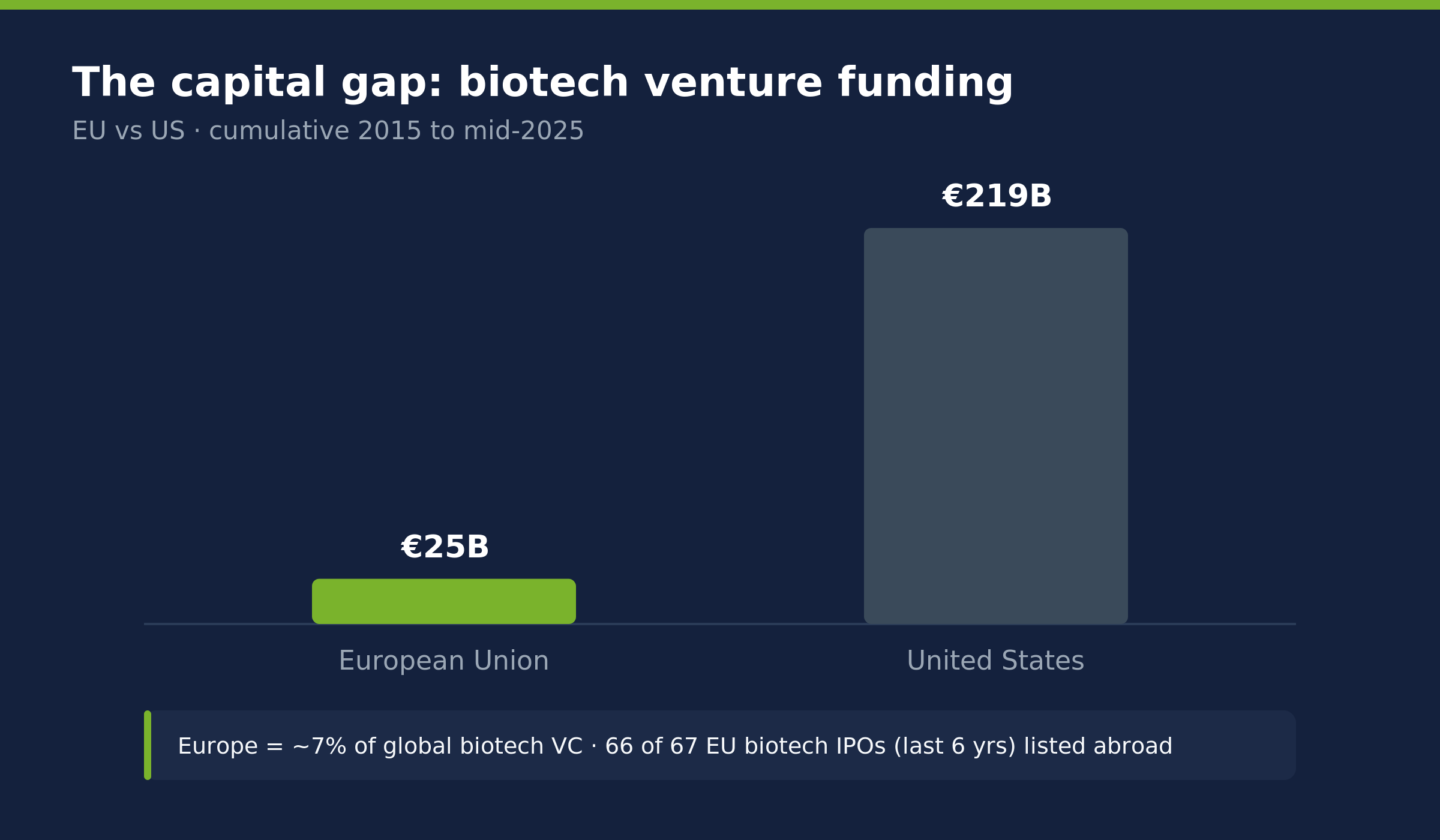
These numbers describe a structural pattern rather than a temporary dip. Early-stage European ventures face a funding drought even as later-stage companies with strong data can attract global syndicates. The result is a continent that discovers reliably and scales reluctantly. For a field like AI drug discovery, where the early advantage is scientific and the decisive battle is at scale, that pattern is a strategic liability.
The spin-off engine is already running
The encouraging half of the story is that the company-building machine exists, and it is busier than the headline numbers suggest. According to Dealroom’s European Spinout Report 2025, 76 deep-tech and life-sciences university spinouts reached either a one billion dollar valuation or 100 million dollars in revenue during 2025, and European university spinouts were on track to raise close to 9.1 billion dollars across the year. A representative sample shows the range of what is being built.
| Venture | Base and origin | Focus | AI approach |
|---|---|---|---|
| Isomorphic Labs | London, spun out of Google DeepMind (2021) | Small-molecule design, oncology | AlphaFold-derived design engine |
| Aqemia | Paris and London, founded 2019 | Oncology, immuno-oncology, RNA targets | Physics-based algorithms with generative AI |
| Owkin / Waiv | Paris, founded 2016; Waiv spun out 2026 | Precision medicine and diagnostics | Machine learning on multimodal patient data |
| 60Nd | Madrid, spin-off of Universidad Carlos III | Mechanomedicine | AI-driven analysis of mechanical forces in cells |
| immunXnano | Germany, spin-off of the DZNE | Immunosafety profiling | AI-assisted modelling of immune interactions |
The pattern in this sample is instructive. Some of these ventures spun directly out of universities and public research centres, carrying intellectual property and a founding scientist. Others were built as independent companies around a computational thesis. Both routes are valid, and both depend on the same scarce ingredients: access to proprietary or hard-to-replicate data, a credible path to clinical or commercial validation, and enough patient capital to survive the years before that validation arrives.
What it takes to build one now
For a university, a hospital, a research group, or a founder sitting on a discovery-stage asset, AI changes the calculation in a concrete way. When the cost of generating and triaging candidates falls, a small team can reach a meaningful scientific milestone on less capital than the previous generation needed. That makes the spin-off a more realistic vehicle than it was five years ago. It does not make the decision automatic. Three questions tend to decide the right path.
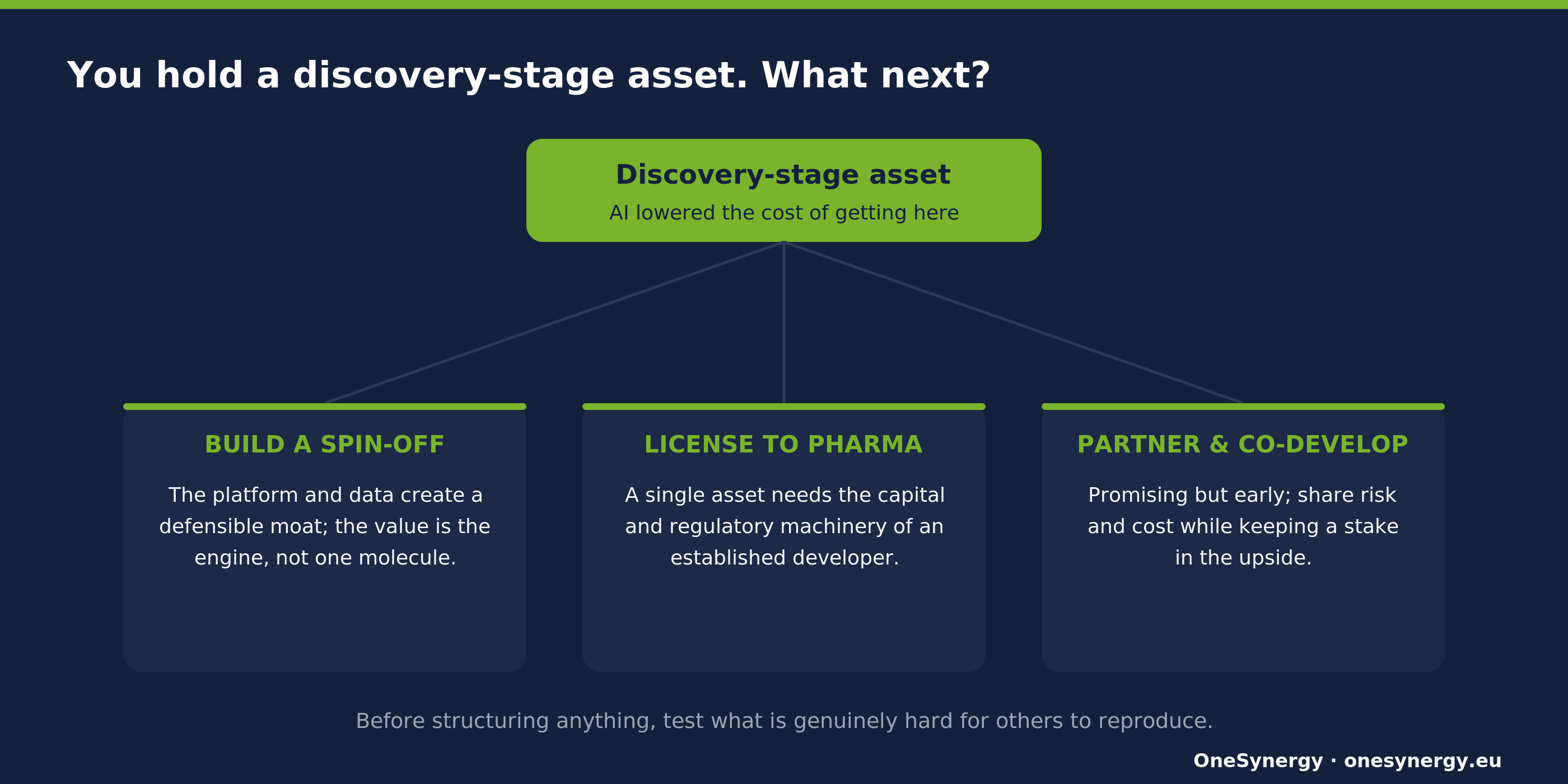
The first is the data question. An AI-driven venture is only as defensible as the data it can train on and the biology it can access. A spin-off with privileged access to clinical data, a unique assay, or a proprietary chemical library has a moat. One that relies only on public models and public data does not. Before structuring a company, the honest test is what exactly is hard for someone else to reproduce.
The second is the build, license, or partner question. Not every discovery should become a company. Some assets are better licensed to an established player with the capital and regulatory machinery to develop them. Others justify a spin-off because the platform, rather than a single molecule, is the value. And some are best advanced through a co-development partnership that shares risk. The decision below is the one founders and technology-transfer offices face directly.
The third is the capital and structure question, and here the European context matters most. The funding gap is real, but the public scaffolding to bridge it has been strengthening. The EIC Accelerator, with its next full-proposal cut-off on 8 July 2026, offers grant and equity specifically for high-risk innovation that private capital alone avoids, and health and biotech sit squarely within its scope. At the policy level, the European Commission proposed a European Biotech Act in December 2025, still moving through the legislative process, designed to speed approvals and channel support toward strategic biotech projects. Industry has moved in parallel, with the formation of a European Life Sciences Coalition by investors including Novo Holdings and Sofinnova Partners. None of these instruments closes the gap with the United States on its own. Together they change what a well-advised European founder can assemble.
The practical implication for leaders is that the spin-off question deserves to be on the agenda now, while AI is resetting the economics of discovery, rather than after the most fundable assets have been licensed away. The organisations that benefit will be the ones that treat company creation as a deliberate strategy: mapping which assets are defensible, deciding early whether to build, license, or partner, and structuring funding around the realities of the European capital stack rather than wishing those realities away.
Europe is unlikely to lose the science. AlphaFold was born in London, and the spinout engine is producing companies at a near-record pace. The open question is whether the continent will build and keep the companies that the science makes possible, or watch the value migrate to markets that fund it more readily. AI has lowered the cost of the discovery. The decision about who builds the company is, as it has always been, a human one.
OneSynergy is a consulting network based in Turin, Italy, advising companies, universities and public institutions on innovation strategy, European funding, and turning research into fundable ventures. If you are weighing whether a discovery-stage asset should become a spin-off, a licence, or a partnership, start a conversation with the network.
Sources: Isomorphic Labs 600 million dollar round (March 2025); Dealroom European Spinout Report 2025 (TechCrunch); EIC Accelerator 2026; European Biotech Act proposal (European Commission, December 2025).
For the framework we apply on EU research and innovation funding — and specifically why portfolio strategy matters more than proposal quality at the point of submission — see the EU Research and Innovation Funding service page.