
Mid-January 2026: Innovation grows up
Mid-January 2026 confirms a clear shift in the innovation landscape: technology is no longer judged by how advanced it looks, but by how reliably it works at scale.
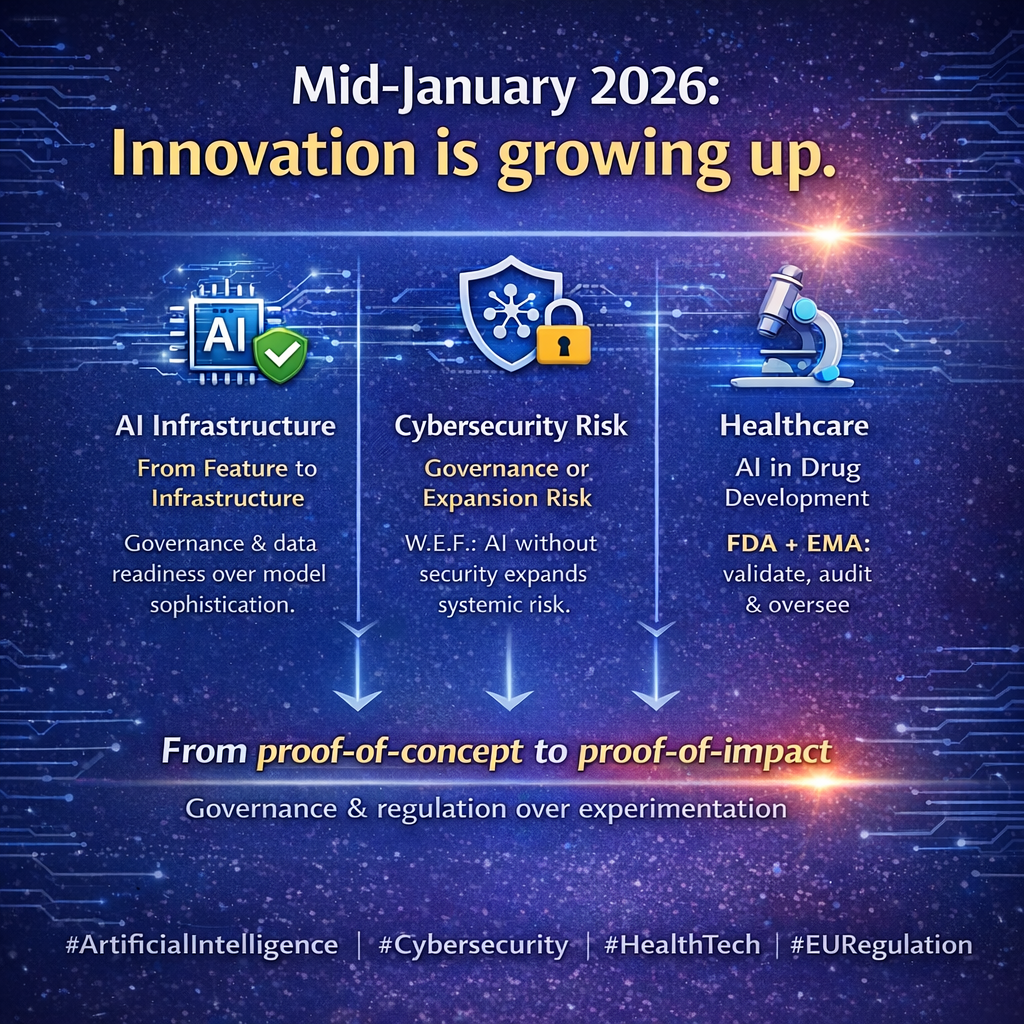
Across AI, cybersecurity, digital health and industry, the dominant signal is maturity. Organizations are moving decisively away from scattered pilots and toward operational, governed and measurable impact. Major advisory firms describe this transition as the move from proof-of-concept to proof-of-impact, where data readiness, integration and accountability matter more than experimental performance alone (Deloitte, Tech Trends 2026).
Artificial intelligence, in particular, is being reclassified. No longer a standalone capability, AI is increasingly treated as infrastructure, tightly coupled with cloud, edge and data platforms. Gartner’s 2026 technology outlook frames AI-native platforms, multi-agent systems and confidential computing as foundational layers rather than optional add-ons, especially in regulated and enterprise environments.
As AI becomes infrastructural, governance and security move to the center of innovation strategy. The World Economic Forum’s Global Cybersecurity Outlook 2026 highlights how automation and AI are expanding systemic risk if not designed with security, resilience and oversight embedded from the start. In this context, cybersecurity is no longer defensive. It becomes a prerequisite for innovation at scale.
This convergence is particularly visible in healthcare. In January 2026, US FDA and the European Medicines Agency jointly released principles for the responsible use of AI across the entire drug lifecycle, from discovery to post-market monitoring (Reuters). The message is unambiguous: regulators support AI adoption, but only when transparency, validation, human oversight and lifecycle control are demonstrable. Speed alone is no longer sufficient.
Industry and infrastructure follow the same logic. Advisory analyses emphasize that AI-enabled automation and digital twins depend less on new algorithms and more on robust architectures, especially the integration of IT and OT systems. At the same time, the expansion of the EU’s NIS2 directive reinforces that digital resilience is now inseparable from industrial innovation.
Finally, Europe is strengthening the technical backbone of trustworthy AI through standards. ETSI’s publication of EN 304 223 on AI cybersecurity signals how standards, regulation and operational practice are converging. Together with the AI Act and NIS2, this standard contributes to a shared framework where trust is engineered, not assumed.
The mid-January picture is therefore coherent and grounded: innovation in 2026 is less about novelty and more about durability. Value emerges where technology, governance and security evolve together. This is not a slowdown. It is innovation growing up.
References and sources
Deloitte – Tech Trends 2026
https://www.deloitte.com/global/en/our-thinking/insights/topics/technology/tech-trends.html
Gartner – Top Strategic Technology Trends 2026
https://www.gartner.com/en/articles/top-technology-trends
World Economic Forum – Global Cybersecurity Outlook 2026
https://www.weforum.org/reports/global-cybersecurity-outlook-2026
Reuters – FDA and EMA set principles for good AI practice in drug development (Jan 2026)
https://www.reuters.com/business/healthcare-pharmaceuticals/us-european-regulators-set-principles-good-ai-practice-drug-development-2026-01-14/
ETSI – EN 304 223, Cyber Security for AI
https://www.etsi.org/committee/cyber-security-for-ai


