

A Horizon Europe grant is won on a proposal and settled on a report. The two documents are read by different people against different rules, and most consortia meet the second set of rules for the first time when their first reporting period closes.
This page sets out how reporting and payments work under the Horizon Europe Model Grant Agreement: what has to be submitted and when, what triggers each payment, and which parts of the file an auditor can come back to years after the project has ended. How we work on this alongside a consortium is described on the EU Grant Financial Management page. If you are still upstream of the signature, how a proposal is evaluated covers the earlier stage.
Two reporting streams run in parallel
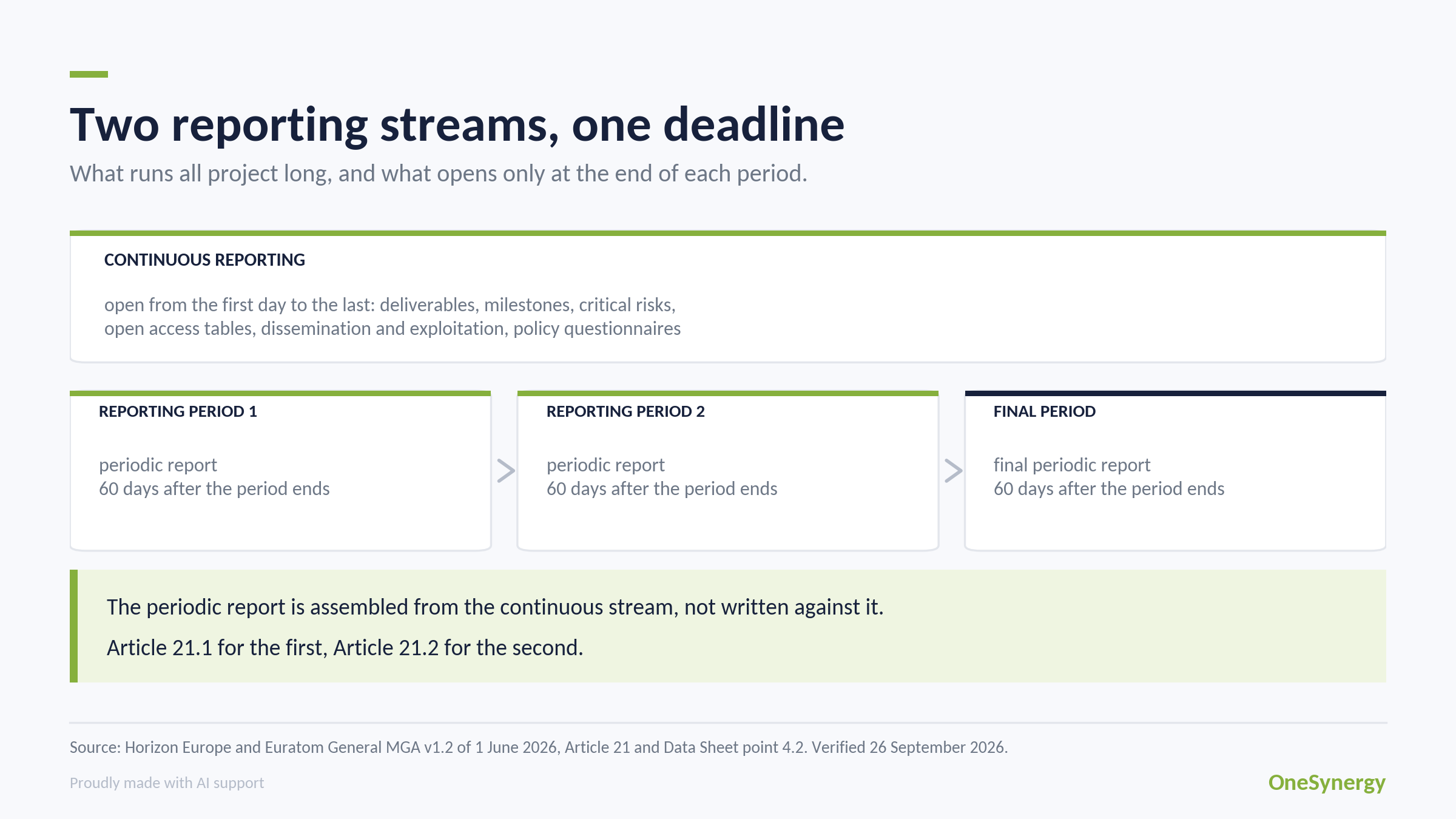
Continuous reporting opens when the project starts and stays open until it ends. It holds the deliverables, the progress on milestones, the follow-up on critical risks, the open access tables for publications and datasets, the dissemination and exploitation activities, the answers to the policy questionnaires and the project summary that is published on CORDIS. Periodic reporting is a separate module that opens at the end of each reporting period and closes when the periodic report is submitted.
Article 21.1 of the Model Grant Agreement governs the first stream, Article 21.2 the second. The distinction matters in practice more than it looks on paper: the periodic report is assembled from what is already in continuous reporting, so a consortium that treats continuous reporting as an end of period task arrives at the deadline with the wrong raw material.
What a periodic report contains, and the sixty days
The technical part comes in two halves. Part A is the structured information already entered through continuous reporting. Part B is a narrative PDF that explains the work carried out, gives an overview of progress and accounts for any deviation from Annex 1, the description of the action.
The financial part holds the individual financial statement of each beneficiary and the consolidated statement, the report on the use of resources with the cost explanations, the information on subcontracting and on in kind contributions by third parties, and the certificates on the financial statements where a threshold is reached. Statements are drafted in euro and the reporting is in the language of the Agreement, in general English.
The deadline is sixty days after the end of the reporting period. Some changes to Annex 1 can be approved ex post in the periodic report instead of through an amendment, which is a separate and slower procedure. Failure to report has graded consequences: the payment deadline is suspended, the measures in Chapter 5 of the Agreement become available and, if the coordinator is the one at fault, the grant or that coordinator’s participation can be terminated.
The payment calendar is contractual, not indicative
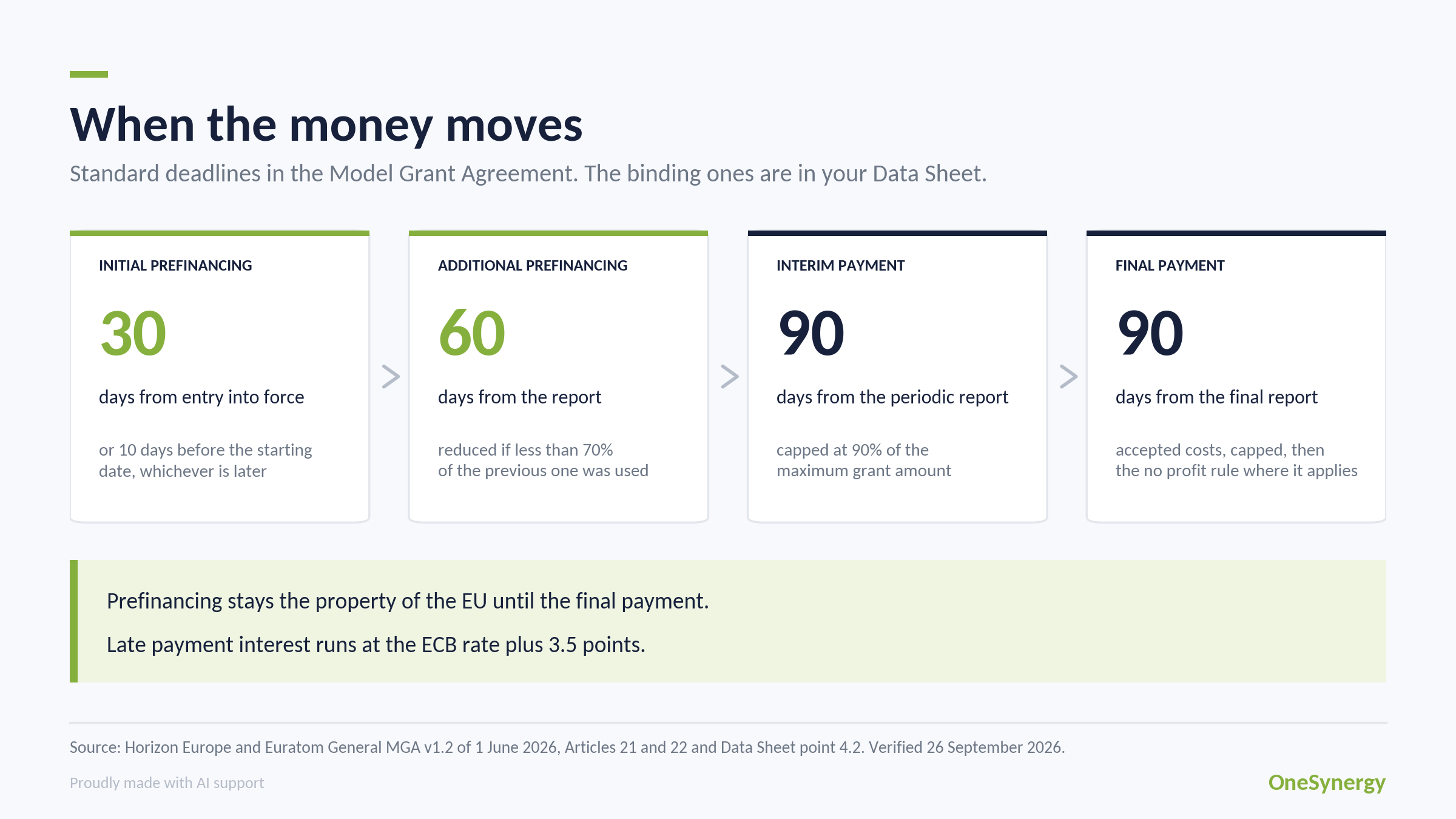
Initial prefinancing is paid thirty days from the entry into force of the Agreement or ten days before the starting date, whichever is the later. Where the grant provides for additional prefinancing, it follows sixty days from the receipt of the additional prefinancing report. An interim payment, where the grant provides for one, follows ninety days from the receipt of the periodic report, and the final payment ninety days from the receipt of the final one.
Those are the standard terms. The figures that bind a specific project are in its own Data Sheet, at point 4.2, together with the reporting periods themselves. Payments are made in euro to the account indicated by the coordinator, who must distribute them without unjustified delay, and late payment interest runs at the European Central Bank rate plus 3.5 points.
The seventy per cent rule, and why prefinancing is not yet your money
Additional prefinancing is not automatic in full. The consortium reports on the use of the previous prefinancing, and if that statement shows less than seventy per cent was used, the next amount is reduced by the difference between the seventy per cent threshold and the amount actually used. A consortium that spends slowly in the first period therefore finances the second one out of its own cash.
Prefinancing is a float, and it remains the property of the European Union until the final payment. That is a legal statement with a practical edge: money received is not revenue recognised, and a partner leaving the consortium does not simply keep what it has been given.
Two ceilings and a no profit check
Interim payments are capped. The general rule in Horizon Europe is an interim payment ceiling of ninety per cent of the maximum grant amount, so at least a tenth of the grant is only released after the final report has been accepted. The final payment is then calculated in three steps: the total accepted EU contribution is established, it is limited to the maximum grant amount, and it is reduced where the no profit rule applies to that grant.
If a beneficiary’s participation ends before the project does, the amount due to it is calculated at that point. A positive balance is added to the next interim or final payment to the consortium, a negative one is recovered.
The certificate on the financial statements is a per partner question
A certificate on the financial statements, the CFS of Article 24.2, is required at final payment when a threshold is reached, and the threshold is measured at beneficiary level, not across the consortium. The standard threshold is a requested EU contribution to costs of EUR 430 000 or more. For a beneficiary that holds a systems and process audit under Article 24.4 the threshold rises to EUR 725 000. In a few types of action, EIT KIC grants among them, the certificate can be required at interim payments as well.
Whether a given partner will need one is knowable while the budget is still being built, and the cost of the certificate is itself an eligible cost. Discovering the obligation at the end of the project, when the auditor has to be appointed in a hurry, is a self inflicted problem.
Personnel costs, the 215 days and the findings that follow
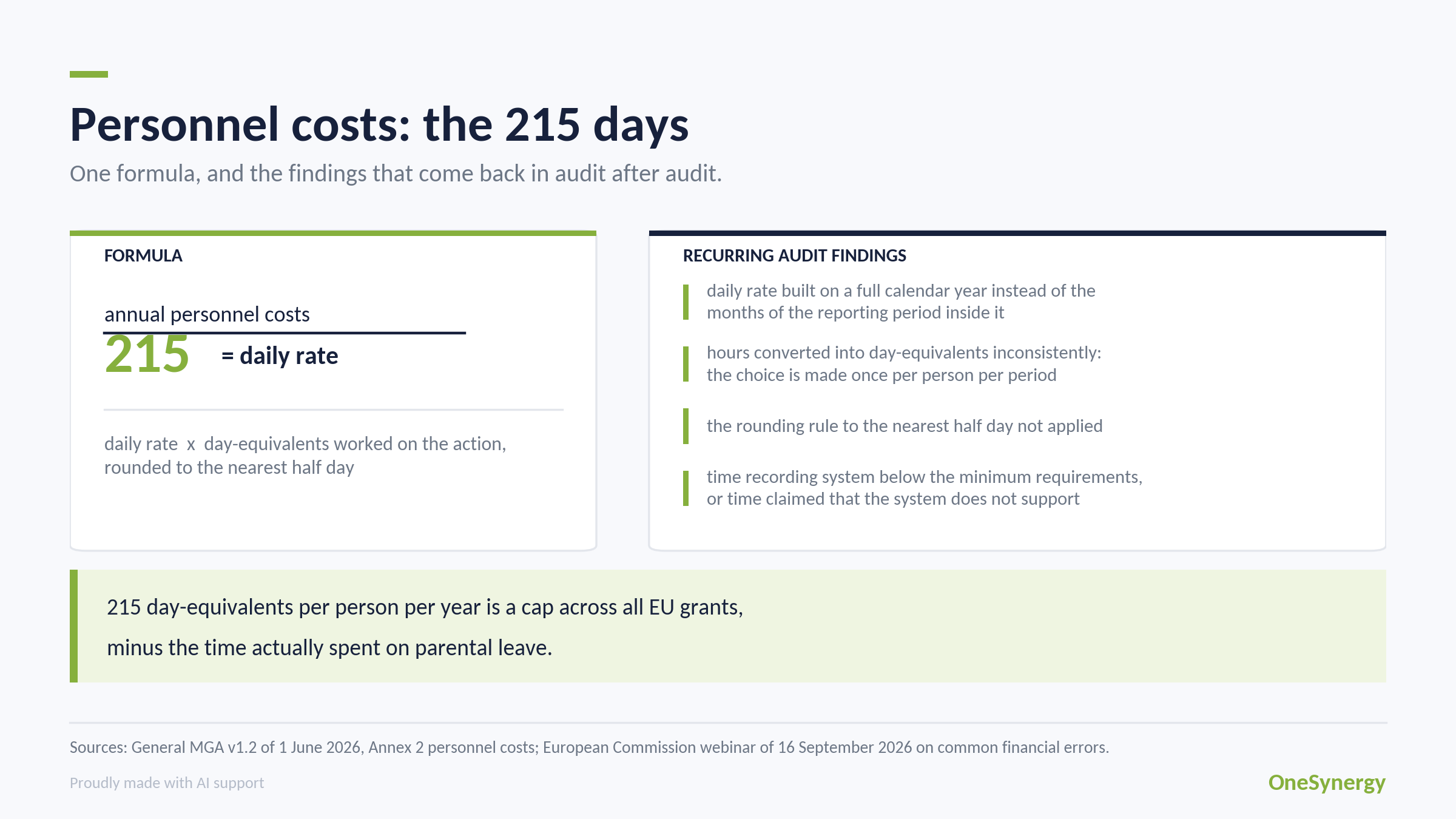
Personnel costs are declared as a daily rate multiplied by the number of day equivalents worked on the action, rounded up or down to the nearest half day. The daily rate is the annual personnel costs for the person divided by 215. Time actually spent on parental leave may be deducted from those 215 days, and across all EU grants a person cannot declare more than 215 day equivalents in a year, minus any parental leave.
The Commission set out the recurring findings on this category in its webinar of 16 September 2026. The daily rate is calculated on a full calendar year instead of the months of the reporting period that fall within it. The conversion of hours into day equivalents is done inconsistently, when the choice between eight hours a day, the average hours in the contract and the standard productive hours has to be made once per person per reporting period. The rounding rule is not followed. The time recording system does not meet the minimum requirements, or the time claimed does not match what the system shows.
Where a time recording system is only partly reliable, the auditors do not stop there. They look for additional or alternative evidence: emails that refer to specific project activities, calendars and meeting agendas, deliverables, the internal project codes, interviews with managers and staff. The webinar presented two cases. Where the time recording system was judged unreliable, the auditors used alternative evidence and accepted only part of the time claimed. Where the system had deficiencies but could still be used, they looked for additional evidence and the time claimed was accepted. In both cases the evidence had to identify the person, link the work to the project and allow the time to be quantified.
The file outlives the project
The Agreement sets standard time limits that all start running from the final payment. Records and supporting documents are kept for five years, or three for grants of not more than EUR 60 000. Project reviews and audits can be launched up to two years afterwards. Findings from another grant can be extended to this one up to two years afterwards. Confidentiality runs for five years, and impact evaluations can take place up to five years afterwards, or three for grants of not more than EUR 60 000.
The extension mechanism of Article 25.5.2 is the one that is underestimated. A systemic or recurrent error found in one grant can be extended to other grants awarded to the same beneficiary under similar conditions, with a correction rate applied by extrapolation. One mistaken practice, repeated across a portfolio, is therefore not one finding but a correction rate applied to the portfolio.
What this changes when you plan
- Reporting periods are negotiable while the grant is being prepared. Their start and duration can be discussed with the project officer, which is the moment to keep a sixty day deadline from landing in the middle of a holiday period.
- The cost model and the time recording system belong to the first month of the project. Both are among the most audited elements, and neither can be reconstructed convincingly afterwards.
- The CFS threshold is a budget line, partner by partner, decided before submission rather than discovered at the end.
- Continuous reporting is a running task. The periodic report is assembled from it, not written against it.
- The audit trail has to survive staff turnover, because the file stays open for years after the last payment.
Sources
- Horizon Europe and Euratom General Model Grant Agreement, version 1.2 of 1 June 2026: Articles 6, 20, 21, 22, 24, 25 and 26, and the Data Sheet at points 4.2, 4.3, 4.4 and 6.
- European Commission, Horizon Implementation Day: Grant Management in Horizon Europe, 3 April 2025: the sessions on amendments, on reporting and payments, and on fraud prevention, detection and corrections.
- European Commission webinar of 16 September 2026, on avoiding the most common financial errors, including the frequent audit findings on personnel costs and time recording.
- Horizon Europe Work Programme 2026-2027, 15. General Annexes, for the budget and cost eligibility framework.
Rules and figures on this page were verified against the primary documents on 26 September 2026. The Model Grant Agreement is revised periodically and the project specific figures always sit in the Data Sheet of the individual grant.
Questa scheda è disponibile anche in italiano.
Talk to the network
If you are choosing between two calls, or you have just read an evaluation summary report and cannot tell what to change, thirty minutes is usually enough to say whether the problem is the text or the position.
If you prefer email, write to info@onesynergy.eu.