

Our page on EU innovation funding sets out why so many good proposals are refused: everything above the threshold joins a ranked list, and the money runs out part of the way down it. This note takes the other half of the question. Not why that happens, but how the machine that produces the list actually works, step by step, and what the General Annexes require at each point.
Admissibility and eligibility are two separate checks
Eligible activities are the ones described in the call conditions. On top of that, eligibility conditions apply both to the consortium and to each participant.
Being eligible to take part is not the same as being eligible for funding. An entity can sit in a consortium and contribute to the work without being funded by the grant. There are also specific cases that run the other way: an affiliated entity established in a country eligible for funding can be funded even when the entity it is affiliated to is not.
Admissibility is a different control. A proposal can be entirely eligible and still be inadmissible, for example because it was submitted through the wrong route or in the wrong format. The general admissibility conditions are the same across calls.
The page limit, and the one case where it is not enforced
Page limits are stated in the topic text and repeated in the template. They are normally applied automatically, which means that pages beyond the limit are removed and never reach the evaluators.
There is an exception worth knowing. In some joint undertaking calls the limit is set section by section rather than on the document as a whole, and the system does not enforce it. Checking the limit yourself, against the template you actually downloaded, is the only reliable approach.
One practical note from the Commission sessions: reformatting a proposal to squeeze it inside the limit is rarely a good use of the last days before a deadline.
Who reads it, and in what order
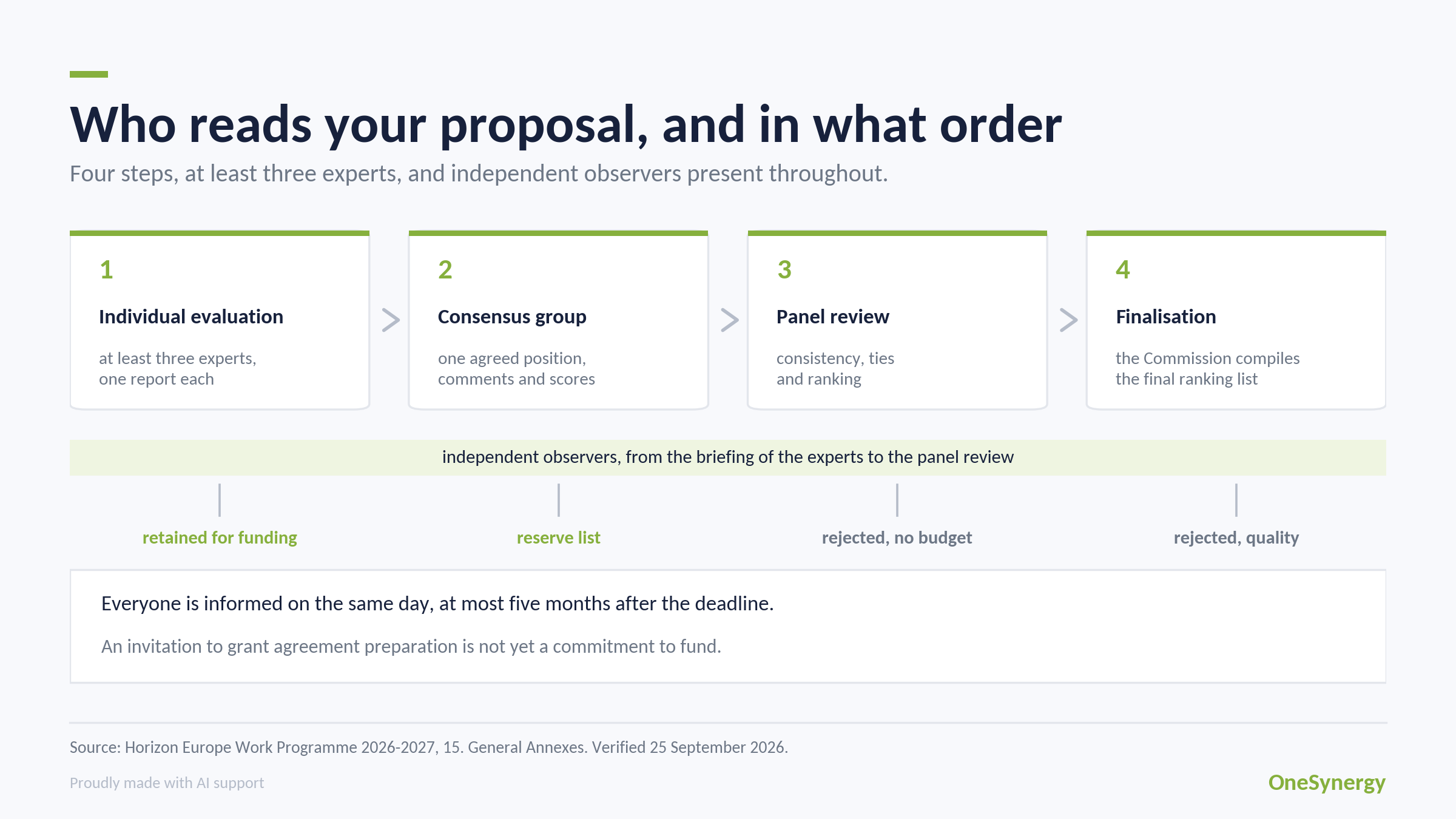
- Individual evaluation. At least three experts assess the proposal independently and each produces an individual evaluation report.
- Consensus group. The experts discuss and agree a common position, including the comments and the score for each criterion.
- Panel review. The panel agrees scores and comments across the call, checks that evaluations are consistent, resolves the cases where evaluators could not agree, and ranks proposals that share the same score.
- Finalisation. The Commission and the agencies review the outcome of the expert evaluation and compile the final ranking list.
Independent observers follow the process from the briefing of the experts through to the panel review, with access to the documents. Their role is to check that the procedure works as it is supposed to.
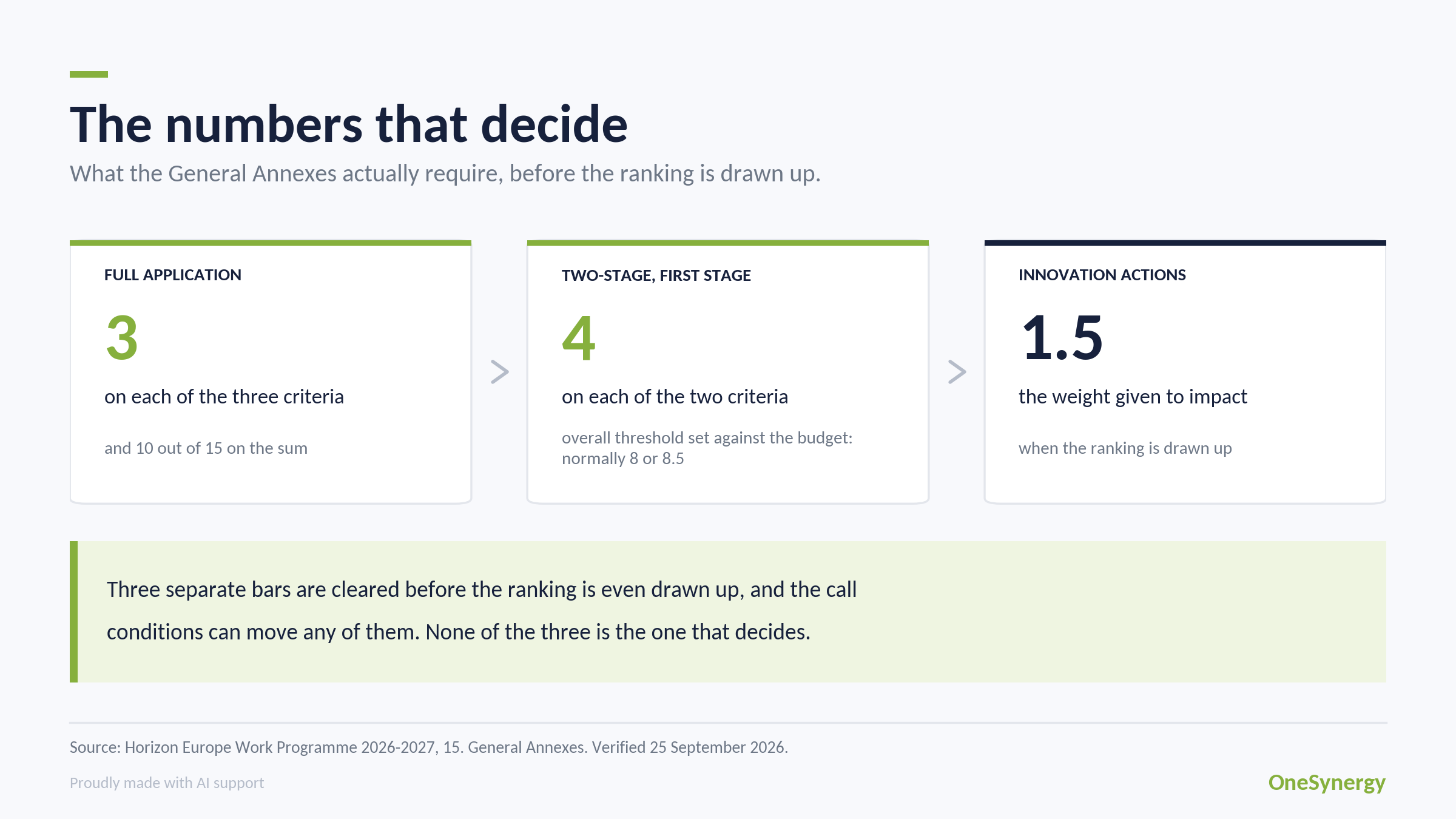
Each criterion is scored out of 5, and experts work from written guidance on what each value means in terms of the number and the seriousness of the shortcomings they find. For full applications the threshold on each individual criterion is 3, and the overall threshold, applied to the sum of the three scores, is 10. For innovation actions the score for impact carries a weight of 1.5 when the ranking is drawn up. Parts of the programme outside the collaborative calls, among them the MSCA actions and the EIC, use their own scoring schemes, so the call conditions remain the document to check.
In two-stage calls a short proposal is assessed first, against two criteria rather than three, and each of them carries a threshold of 4. The overall threshold for the first stage is not a fixed number. It is set so that the total budget requested by the proposals admitted to the second stage comes as close as possible to three times the budget available, and never falls below twice that amount. Where it lands therefore depends on how many proposals arrived, although in practice it is normally set at 8 or 8.5.
Two thresholds, and only one of them is published
The quality threshold is the minimum. A proposal below it is rejected on quality, and that is the end of it.
The budget threshold is not a rule, it is a consequence. Once the ranking is complete it is worked down from the top, funding proposals until the money available for that call runs out. Where the line falls depends on how many strong proposals that particular call attracted, and it cannot be known in advance. There are calls in which the budget is exhausted by proposals holding the highest possible scores.
Applicants are not told how far they were from the line. The result letter will not say whether you missed by a place or by fifty, which is why the ranking cannot be reverse engineered from one outcome.
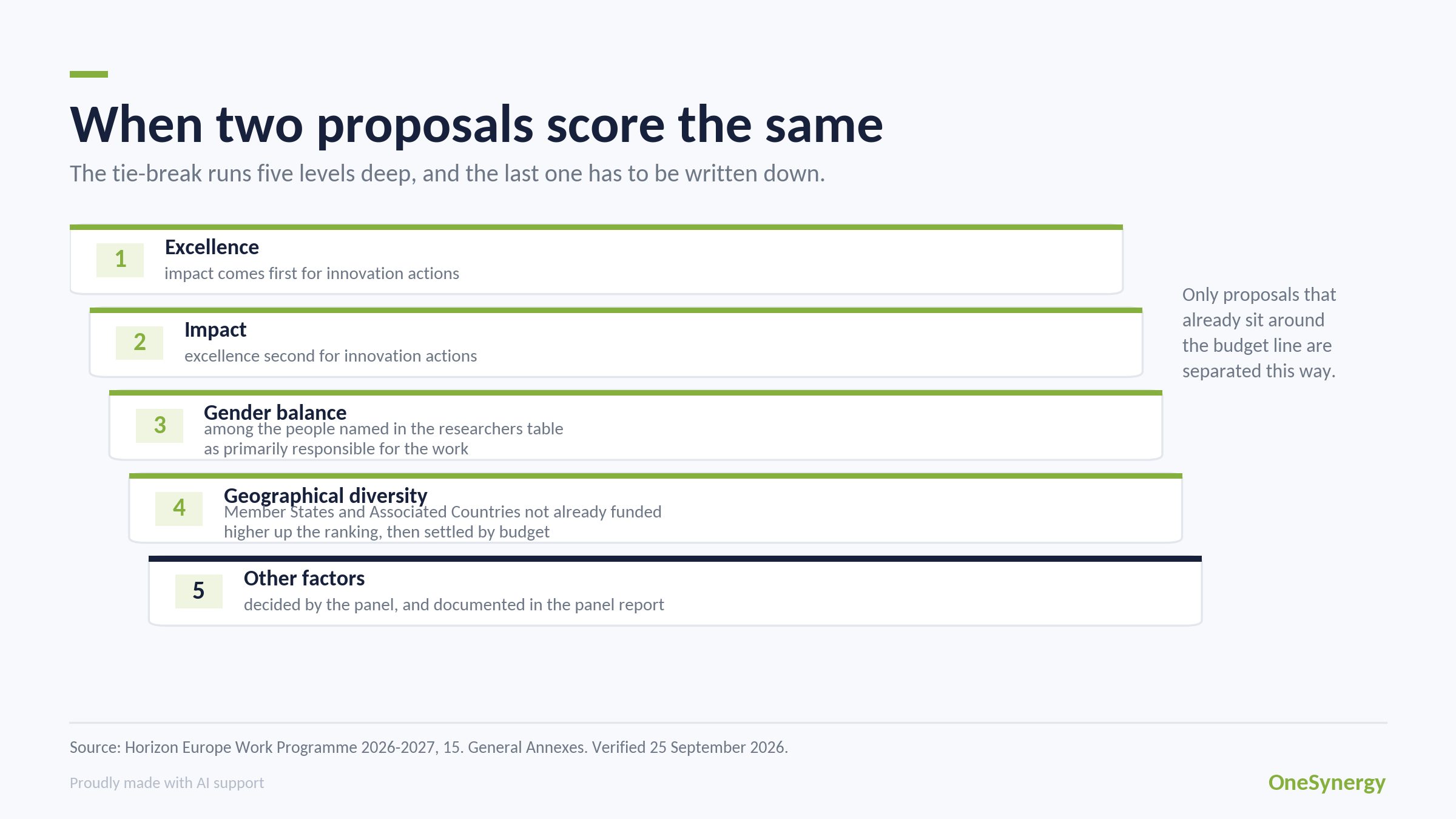
Proposals on identical scores within the same budget envelope are ordered by a procedure set out in the General Annexes, unless the call conditions provide otherwise, and it runs deeper than most applicants expect. Priority goes first to proposals that address aspects of the call not already covered by proposals ranked higher. Among those, excellence is considered first, then impact, with the order reversed for innovation actions, where impact comes first. If the tie holds, the next factor is the gender balance among the researchers with a leading role named in the researchers table. After that comes geographical diversity, counted as the number of Member States or Associated Countries represented in the proposal that are not already receiving funds from projects higher up the ranking, and settled by budget if that count is equal too. Only then may the panel weigh other factors related to the objectives of the call, and whatever it weighs has to be written into the panel report.
Being invited is not yet being funded
Proposals that make it through are invited to grant agreement preparation. That invitation is not a formal commitment to fund: several legal checks still follow, and a proposal can be rejected at that stage, or in part, if costs turn out to be significantly over or under estimated.
The first proposals excluded for lack of budget, provided they are above the quality threshold, go to a reserve list. Position in that list matters, because budget can become available later: funds left over elsewhere in the programme are sometimes used to finance excellent proposals held in reserve.
Being on a reserve list does not stop you from submitting to another call in the meantime.
Ethics runs through the whole process
Ethics review is carried out systematically, starting from the self-assessment included in the proposal. Proposals selected for funding go through a deeper review with ethics experts, which can lead to recommendations, a request for further clarity, or an additional review. Ethics compliance is treated as part of the research from beginning to end, not as a formality at application stage.
When you find out, and what you receive
The time to inform is at most five months from the call deadline. The Regulation allows this period to be exceeded for ERC actions, for missions and for proposals that undergo an ethics assessment or a security scrutiny. In two-stage calls the first-stage result normally arrives about three months after the deadline. Applicants receive an evaluation result letter together with the evaluation summary report.
There are four possible outcomes: retained for funding and invited to grant agreement preparation, placed on the reserve list, rejected because the budget was insufficient, or rejected because the quality was not sufficient.
Two-stage calls work slightly differently. Proposals that pass the first stage do not receive an evaluation summary report at that point: general feedback is published as a call update on the portal, and their first-stage report is sent together with the one from the second stage. The procedure for proposals on identical scores does not apply to the first stage.
What this changes when you plan
The evaluation summary report is the only document that explains why, and it is worth reading closely before deciding whether to resubmit, where, and with what changes.
Before submitting, a useful test is to hand the proposal to a colleague and ask them to read it as an evaluator would, then say whether something essential is missing or something is repeated. Writing towards a particular score is not a productive approach, because the score follows the substance rather than the other way round.
Sources
- European Commission, Horizon Implementation Day: Finding opportunities and submitting a proposal in Horizon Europe, 24 September 2026
- European Commission, Horizon Implementation Day: Finding opportunities and submitting a proposal in Horizon Europe, 13 March 2025
- Horizon Europe Work Programme 2026-2027, 15. General Annexes, sections on admissibility, eligibility, award criteria, scores and thresholds, and the procedure for proposals with equal scores. Verified 27 October 2026
- Regulation (EU) 2021/695, for the time to inform and for the ethics provisions
Questa scheda è disponibile anche in italiano.
Talk to the network
If you are choosing between two calls, or you have just read an evaluation summary report and cannot tell what to change, thirty minutes is usually enough to say whether the problem is the text or the position.
If you prefer email, write to info@onesynergy.eu.